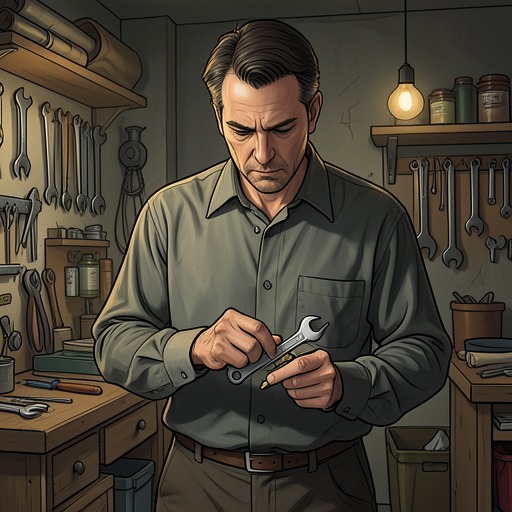
Ove rebuilds his parents’ house
A Man Called OveOve rebuilds his parents’ house in defiance of a municipal plan to demolish it, making repair both a practical answer to displacement and an act of loyalty to the family he has lost. The project begins when he is eighteen and ends with a house he has remade largely through his own labor. Its lasting importance is visible much later in the low kitchen counter and the wheel marks left by his wife’s repeated journeys through the room: this is not simply a building saved from demolition, but a home that continues to bear the marks of the life lived inside it.
The house threatened by change
A week after his eighteenth birthday, Ove passes his driving test and walks fifteen miles to buy his first car, a run-down blue Saab 93. He has sold Ove's Father's Saab 92 to pay for it. The purchase gives him a hard-won possession of his own, but his attention soon turns to a more consequential piece of property: the house his parents left him.
The country around him is changing. New housing developments, carefully trimmed lawns, televisions, and talk of a growing middle class make the old house seem increasingly out of place. It stands at the edge of a former village, beside the new development, and directly on a boundary between two municipal authorities. The council sends Ove several letters about redrawing that boundary and tells him it intends to force a sale of the land so the house can be demolished and replaced. The paperwork is difficult for him to understand, but its practical meaning is clear: the home will be removed to make way for progress as defined by others.
The house is in no condition to resist such a plan. Ove's father understood machines better than building, and Ove has little construction experience himself. He uses only the kitchen and the small room beside it; upstairs, mice have begun to take over. Yet he cannot bring himself to sell. He may dislike the council’s tone, or he may be holding on because the house is all that remains of his family. The reason is not settled even for Ove. What matters is the decision: rather than surrender the property, he will repair it.
Learning by labor
Ove does not know how to rebuild a house. He cannot distinguish a dovetail joint from a pot of potatoes, so he looks for a way to learn. Since his new working hours leave him free during the day, he applies for work at a nearby construction site. The foreman can offer only a laboring job. Ove accepts it, treating access to a building site as an education that matters more than the job title.
His schedule leaves little room for rest. At night he picks up litter on the line heading south out of town; after three hours of sleep, he goes to the construction site and listens to the men in hard hats discuss their work while moving across the scaffolding. On his one free day each week, he hauls sacks of cement and wooden beams for eighteen hours at a stretch, dismantling and rebuilding the only thing his parents left him besides the Saab and his father’s wristwatch. The work builds his strength, and he learns quickly.
The instruction comes through both observation and blunt correction. When Ove damages the living-room wall, a wiry colleague first tells him at length what he has done wrong, then teaches him to calculate load-bearing requirements. When he lays the kitchen floor, a heavier colleague with a missing little finger calls him a bonehead before showing him how to measure properly. Their help is unsentimental, but specific: they turn mistakes into usable knowledge rather than leaving him to fail alone.
The foreman quietly contributes materials as well. He takes Ove to discarded planks and offers a deliberately indirect permission to take what he needs. Later, a toolbox of used tools appears beside Ove’s work clothes with a note addressed to a puppy. Neither gift is presented as a grand act of rescue. The timber and tools simply become part of the means by which the young man can finish what he has begun.
A house remade, piece by piece
The rebuilding proceeds slowly, screw by screw and floorboard by floorboard. Ove’s colleagues hear about the project and occasionally ask after it; the account of their advice and the tools left for him shows that the house is his undertaking, but not one sustained entirely in isolation. Ove does not need an audience for the result. The satisfaction lies in doing the work properly, in keeping with the lesson his father had taught him: a job well done is its own reward.
A few weeks after he starts, Ove drives the last nail. At sunrise he stands in the garden, hands in the pockets of his navy trousers, surveying the completed work. The scene reverses the image with which the project began: the young owner sitting for hours in his newly bought car, looking at a decrepit house and waiting, almost, for it to repair itself. It does not repair itself. He has had to learn, work, and finish it with his own hands.
His attachment to the building is practical as well as familial. Houses can be drawn and calculated; if made watertight, they do not leak, and if properly supported, they do not collapse. Ove sees them as fair because they give a dependable result when someone does the work they require. That assurance stands in contrast to his judgment of people, who do not always give back what effort seems to deserve.
The home’s continuing history
The rebuilt house remains a lived-in home rather than a completed project left behind. After an accident leaves Ove’s wife with limited mobility, he rebuilds the kitchen himself. Its stove and counter are lower than usual, and repeated journeys through the room have left soft wheel marks across the floor. When Parvaneh sees those marks, the adapted space communicates a history that its construction alone cannot: Ove has again changed the house to meet the needs of the person living in it. The council refuses to help, so the practical work falls to him once more.
The house also persists as a place of daily responsibility. Years later, in the winter close to four years after Parvaneh and Patrick’s trailer accident, Parvaneh wakes at a quarter past eight and notices that the snow outside Ove’s home has not been cleared. The absence of his usual work sends her running across the road to check on him. The episode does not diminish the original rebuilding; it shows how the house, its surroundings, and the routines Ove maintains have become legible to his neighbors as signs of his presence.
Ove’s decision to rebuild therefore shapes more than the appearance of a neglected property. The house is saved from the council’s proposed demolition, made habitable through skills acquired by relentless work, and later adapted again through hands-on care. Its walls and floors register successive acts of maintenance, while its usefulness gives Ove a form of certainty that he does not find in human affairs. The young man who refuses to let the house be erased will continue to express care by making the places around him work.